Summer Pickleball Paddle ITh Bag Tag
A Designer’s First Look: Bright, Playful—and Purpose-Built
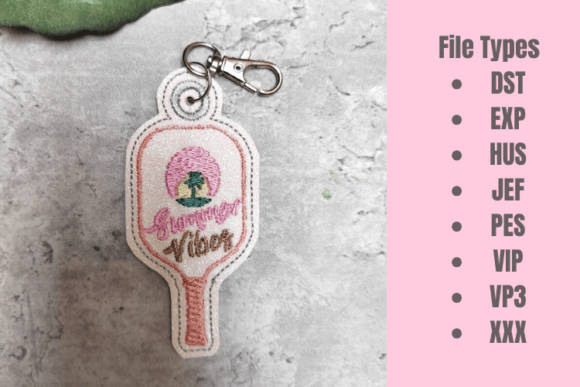
When I opened the Summer Pickleball Paddle ITh Bag Tag file, my first thought wasn’t “cute” or “trendy”—it was “this has intent.” The shape is a clean snap-tab silhouette—slightly elongated, with gentle curves that echo a real paddle’s outline. Inside, the pickleball graphic pops with balanced negative space, and the “ITH” (in-the-hoop) structure suggests thoughtful construction, not just decoration. It reads as joyful but not childish, sporty but not aggressive—ideal for summer-themed handmade products where personality matters more than precision.
Where It Shines: Real Projects, Real Customers
I tested the Summer Pickleball Paddle ITh Bag Tag on three real-world items: a cotton twill tote bag for a local pickleball league fundraiser, a lightweight linen apron for a boutique kitchen shop, and a set of organic cotton baby onesies for a small Etsy seller. On the tote, it stitched cleanly with crisp satin-stitched edges and a subtle fill-stitch background—no puckering, no thread breaks. The apron showed off its charm best: the design’s open layout let the fabric’s natural texture breathe, and the contrast between stitch and linen felt intentional, not forced. Even on the onesies—where fine detail can vanish—the paddle’s bold outlines held up well after washing.
This isn’t a design that begs for center-stage on a sweatshirt chest. It’s quieter, smarter. It works beautifully as an embroidered patch sewn onto a cap brim, a tag stitched into the seam of a holiday gift bag, or a personalized accent on a tea towel folded in a boutique display. For Etsy sellers and craft fair vendors, it adds instant thematic cohesion to summer collections—especially when paired with matching digital embroidery files like sun motifs or citrus accents.
Where to Proceed Thoughtfully
The Summer Pickleball Paddle ITh Bag Tag doesn’t hide its limitations—and that’s why I trust it. Its open areas and moderate stitch density make it forgiving on textured fabrics like terry cloth or bouclé, but avoid using it on highly stretchy knits (think performance tees or baby leggings) without a firm cutaway stabilizer and test stitching. On dark fabric, the inner details—like the tiny ball texture or subtle “ITH” lettering—can soften unless you choose high-contrast thread colors. And while it fits comfortably in a 4x4 hoop, pushing it into a 3x3 requires trimming or simplifying; those curved paddle edges need breathing room.
I wouldn’t recommend it for layered garments like quilted jackets or curved surfaces like structured baseball caps—unless you’re experienced with hooping techniques and willing to adjust tension manually. The design includes no dense fill zones, so it won’t overwhelm thin fabrics like voile or silk-blend scarves—but also won’t hold up visually on heavy canvas without slight enlargement.
What It Adds to Your Finished Product—Beyond Stitching
Customers notice intentionality. When I attached the Summer Pickleball Paddle ITh Bag Tag to a custom embroidered pillow cover, buyers didn’t just comment on the stitching—they mentioned how “cohesive” and “thought-out” the whole piece felt. That’s the quiet power of a well-scaled, context-aware machine embroidery design. It elevates perceived value without demanding premium pricing. For small shop owners, that translates directly to repeat customers and word-of-mouth referrals.
It also strengthens brand consistency. A craft business selling summer-themed handmade products can use this design across multiple SKUs—tote bags, aprons, patches—without visual fatigue. Unlike overly intricate designs that demand perfect lighting or close inspection, this one reads clearly at arm’s length and holds up in printable mockups for social media or Etsy listings. That reliability builds trust—not just in your craftsmanship, but in your curation.
Practical Notes Every Embroidery Designer Should Check
- Always test on scrap fabric first—especially if pairing with textured or dark materials.
- Review thread color contrast before finalizing—light threads on light fabric can mute key details.
- Confirm hoop size compatibility before digitizing adjustments; the original layout assumes standard ITH tab proportions.
- Inspect small corners and curves under magnification—those paddle tips should land cleanly, not distort.
- Test in black-and-white mockups to assess clarity and balance without color bias.
- Compare performance on light vs. dark backgrounds—some fill-stitch areas may require slight density tweaks.
- Use appropriate stabilizer: medium-weight tear-away for stable wovens, cutaway for knits or loosely woven linens.
- Verify licensing terms before selling finished products or bundling the Summer Pickleball Paddle ITh Bag Tag as part of a commercial embroidery collection.
Final Thought: A Design That Serves the Project, Not the Ego
There’s a quiet confidence in the Summer Pickleball Paddle ITh Bag Tag. It doesn’t shout. It doesn’t overcomplicate. It solves a specific problem—adding playful, seasonal identity to functional items—with restraint and clarity. As a designer who’s stitched hundreds of embroidery files for clients, small businesses, and personal projects, I appreciate how rarely a design feels *just right* for its intended role. This one does. Whether you’re an Etsy seller building a summer launch, a craft fair vendor refreshing booth inventory, or a hobbyist making gifts for fellow players—it delivers clean results, consistent appeal, and real-world versatility. Just remember: even the best machine embroidery design earns its keep only when matched with thoughtful execution. So stitch mindfully, test generously, and let the Summer Pickleball Paddle ITh Bag Tag do what it does best—add joy, purpose, and polish, one finished product at a time.