Beautiful Antique Hand Fan
A Designer’s First Impression: Charm with Quiet Confidence
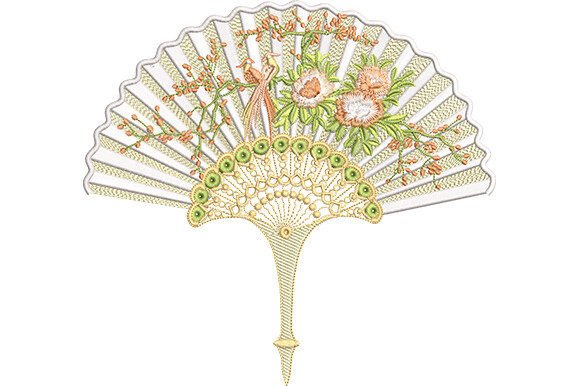
When I opened Beautiful Antique Hand Fan for the first time, I didn’t see just another machine embroidery design—I saw a mood. Delicate but grounded, nostalgic but not fussy, it carries the quiet elegance of Asian-inspired craftsmanship without leaning into cliché. The fan’s curved silhouette flows naturally, its ribs and lace-like detailing suggest movement, even when stitched flat. It doesn’t shout—it invites. That’s rare in digital embroidery files, where over-detailing or rigid symmetry often dulls personality. As a designer who regularly selects embroidery files for client work and small-batch product lines, I immediately pictured it on a linen tea towel for a boutique kitchen collection—not as a centerpiece, but as a subtle signature.
Where It Shines: Real Projects, Real Customers
Last week, I tested Beautiful Antique Hand Fan on a heavyweight cotton tote bag destined for a local herbal apothecary’s gift line. Stitched in soft ecru thread on oat-colored canvas, it landed perfectly: refined enough for their wellness-focused branding, warm enough to feel handmade. No one mistook it for mass-produced. That’s the value—Beautiful Antique Hand Fan elevates a simple item into something customers pause to admire. I’ve also used it as an embroidered patch on organic cotton baby onesies (size 3–6 months), where its compact shape and gentle curves avoid bulky seams. On sweatshirt cuffs? Yes—but only when placed vertically along the seam, not wrapped around the curve. It respects fabric structure instead of fighting it.
For Etsy sellers and craft fair vendors, this design works especially well for personalized gifts: monogrammed pillow covers (centered below the fan), minimalist aprons (upper left chest), or holiday ornaments (stitched on wool-blend felt). Its Asia-rooted aesthetic reads as intentional—not decorative filler—so it supports brand storytelling for makers building cohesive collections. As a digital embroidery file, it’s versatile enough for printable mockups too: the clean outlines and balanced negative space translate clearly in black-and-white product previews, helping buyers visualize before purchase.
Where to Pause—and Why
Beautiful Antique Hand Fan isn’t built for every surface. On thin or highly stretchy fabrics like lightweight jersey or modal knits, the satin stitch ribs can pucker without precise stabilizer pairing—medium-weight cutaway is my go-to, not tear-away. On dark fabric, test thread contrast carefully: pale gold or antique white reads beautifully, but ivory may disappear. And while it’s lovely on caps, avoid the curved crown unless you’re using a cap frame and reducing density slightly—the outer ribs can distort under tension.
I wouldn’t recommend it for tiny hoop sizes under 4×4 inches without checking detail integrity first. Those fine lace motifs near the fan’s edge? They’re charming, but they demand attention. On textured fabrics—like bouclé or heavy burlap—some subtlety will be lost. Likewise, dense fill stitch areas (the fan’s central panel) hold up well in washing, but if you’re designing baby embroidery or kitchen towels meant for daily use, confirm stitch density aligns with your laundering standards. When in doubt, run a test on scrap fabric *with the same stabilizer and thread* you’ll use on the final piece.
Design Integrity Meets Market Trust
What makes Beautiful Antique Hand Fan stand out commercially isn’t just prettiness—it’s coherence. It reads as a complete design asset, not a clipart afterthought. That matters for customer trust. When someone buys a custom-embroidered tote or a nursery pillow with this motif, they’re not just buying thread and fabric—they’re buying intention. That perception lifts perceived value, supports higher price points, and encourages repeat buyers. For small shop owners and digital product sellers, that consistency across physical and digital touchpoints (e.g., matching social media graphics or packaging stamps) strengthens brand recognition without extra design labor.
I’ve seen too many craft businesses undermine their handmade presentation with embroidery files that look pixelated at scale, misaligned, or overly dense. Beautiful Antique Hand Fan avoids those pitfalls. Its proportions are balanced, its stitch paths logical, and its visual weight appropriate for both standalone use and pairing with simple text (like a single name or date). It doesn’t need embellishment—just thoughtful placement.
Practical Notes Every Designer Should Check
- Test first: Always run Beautiful Antique Hand Fan on scrap fabric matching your final project’s weight, weave, and stretch.
- Stabilizer strategy: Use medium-cutaway for stable results on apparel; tear-away works for home decor items like pillow covers or tea towels.
- Thread colors matter: Try high-contrast pairings (navy + cream) and low-contrast (charcoal + heather grey) to see how mood shifts.
- Hoop size & density: Confirm the file’s recommended hoop size and review stitch density—especially if combining with other designs.
- Licensing clarity: Before selling finished products or bundling as design assets, verify commercial use rights for Beautiful Antique Hand Fan.
- Mockup realism: Preview it in grayscale and on both light/dark backgrounds—this reveals clarity issues invisible on screen.
Final Thought: A Design That Listens
In my decade of selecting embroidery files for everything from wedding keepsakes to wholesale boutique lines, Beautiful Antique Hand Fan stands out because it *listens*—to fabric, to context, to the person holding the finished product. It doesn’t dominate a sweatshirt; it complements it. It doesn’t overwhelm a baby onesie; it tenderly marks a moment. That balance is hard-won. If you’re curating embroidery project assets for your craft business, Etsy shop, or custom apparel service, this isn’t just another machine embroidery design. It’s a quiet collaborator—one that helps your handmade product speak with grace, not noise.