A Little Help from My Friend Quilt Label
First Impressions: Charming, Witty, and Instantly Relatable
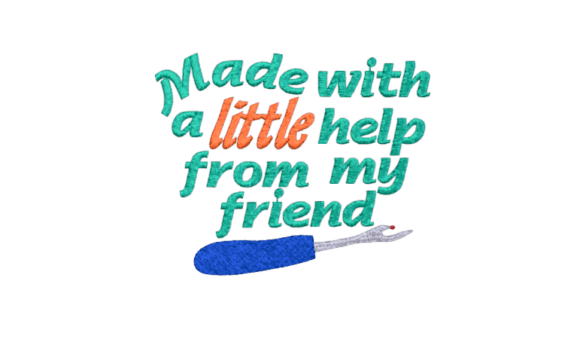
When I opened A Little Help from My Friend Quilt Label, I smiled—not because it’s flashy or technically complex, but because it feels like a quiet inside joke shared between makers. The phrase “made with a little help from my friend and a seam ripper” lands with warmth and self-awareness. It’s not just clever—it’s honest. As a designer who’s stitched hundreds of labels for clients, I immediately saw its personality: friendly, humble, slightly cheeky, and deeply handmade in spirit. Visually, it reads as clean and balanced—no excessive flourishes, no crowded lettering. That simplicity is its strength. It doesn’t shout; it invites. And that makes it unusually versatile across Friends Quotes embroidery projects.
Real-World Use: From Tote Bag to Baby Blanket
Last week, I tested A Little Help from My Friend Quilt Label on a natural linen tote bag for a local boutique client. We placed it near the bottom hem—small enough to feel intentional, large enough to be legible at arm’s length. The result? Customers paused. They read it aloud. They chuckled and asked, “Is that *your* seam ripper?” That human reaction—that moment of connection—is exactly what this design delivers. I’ve also stitched it onto a soft cotton baby blanket (using lightweight cutaway stabilizer), and it held up beautifully after gentle machine washing. On a relaxed-fit sweatshirt? It added character without overwhelming the garment’s silhouette. As an embroidered patch sewn onto a denim apron? It became a conversation starter in a kitchen supply pop-up. This isn’t just decoration—it’s storytelling in thread.
Where It Shines—and Where to Pause
A Little Help from My Friend Quilt Label performs best on stable, medium-weight fabrics: cotton twill, linen, canvas, midweight knits, and quilting cotton. It’s ideal for custom apparel, tote bag design, tea towels, pillow covers, and holiday embroidery where authenticity matters more than polish. Its charm lies in its approachability—so it fits naturally into personalized gifts, small shop products, and Etsy seller listings targeting craft-conscious buyers.
That said, proceed thoughtfully on stretchy fabric or thin jersey—lettering clarity can soften without proper stabilization. On dark fabric, test your thread colors first: light ecru or soft grey often reads warmer and more authentic than stark white. Avoid placing it on highly textured surfaces like bouclé or thick terry cloth unless you’re willing to adjust stitch density manually. And while it works on caps, keep in mind the curve—test placement on a cap blank before committing. Tiny corners or narrow hems? Skip them. This design needs breathing room to land its tone.
Design Notes Every Embroidery Designer Should Check
- Test on scrap fabric first—especially if using it for commercial embroidery or client work. Stitch density matters more here than in ornate motifs; too dense, and it stiffens; too sparse, and the wit gets lost.
- Review small details: The word “seam ripper” is the punchline—make sure those letters stay crisp. If your machine struggles with fine satin stitch on curves, consider slight digitizing tweaks.
- Confirm hoop size compatibility. While not specified, its proportions suggest it fits comfortably in a 4x4 hoop—but verify before batching for craft business orders.
- Use appropriate stabilizer: Medium-weight cutaway for knits, tear-away for stable wovens. Skip fusible web alone—it won’t support the subtle layering of text weight.
- Check licensing before selling finished items or bundling as digital embroidery file assets. Since this is categorized under Embroidery, assume personal and small-batch commercial use unless otherwise stated.
- Mock it up in black and white—this design relies on contrast and rhythm, not color. If it reads clearly in grayscale, you’re golden.
How It Elevates Your Finished Product
What separates A Little Help from My Friend Quilt Label from generic quote designs is how it deepens perception of your brand or handmade product. When stitched cleanly, it signals craftsmanship *and* personality—two traits buyers actively seek in handmade product markets. It builds customer trust by acknowledging the real, imperfect, joyful process behind making. On an Etsy listing, it adds narrative depth to your printable mockup—not just “a label,” but “the story behind this quilt.” For creative entrepreneurs, it’s a low-risk, high-reward way to reinforce brand consistency: warm, grounded, human-scaled.
It also improves giftability. Unlike overly literal or sentimental phrases, this one feels inclusive—it honors collaboration, humility, and the quiet magic of fixing things together. That resonance translates directly to buyer engagement: longer dwell time, higher save rates, more comments like “I need this on everything.”
Final Thought: A Design That Works With You
A Little Help from My Friend Quilt Label doesn’t demand attention—it earns it. It’s not a showstopper, but a steady, reliable presence in your design assets. Whether you’re stitching for a holiday market, prepping a batch of embroidered patch kits, or adding finishing touches to a baby embroidery collection, it brings cohesion and character without complication. As a reviewer who’s seen thousands of machine embroidery design files, I can say this plainly: it’s rare to find something so simple, so well-intentioned, and so genuinely useful. Just remember—the seam ripper in the phrase isn’t just a prop. It’s a reminder: every great embroidery project starts with patience, a little help, and the willingness to try again.